How to Find the Part Number
of an auto part (4 paths)
The part number is the exact language of auto parts: with it there is no ambiguity about trim or engine. The problem is that almost nobody has it on hand. These are the 4 paths to find it, from the most reliable to the emergency one, and what to do when none of them turns up.

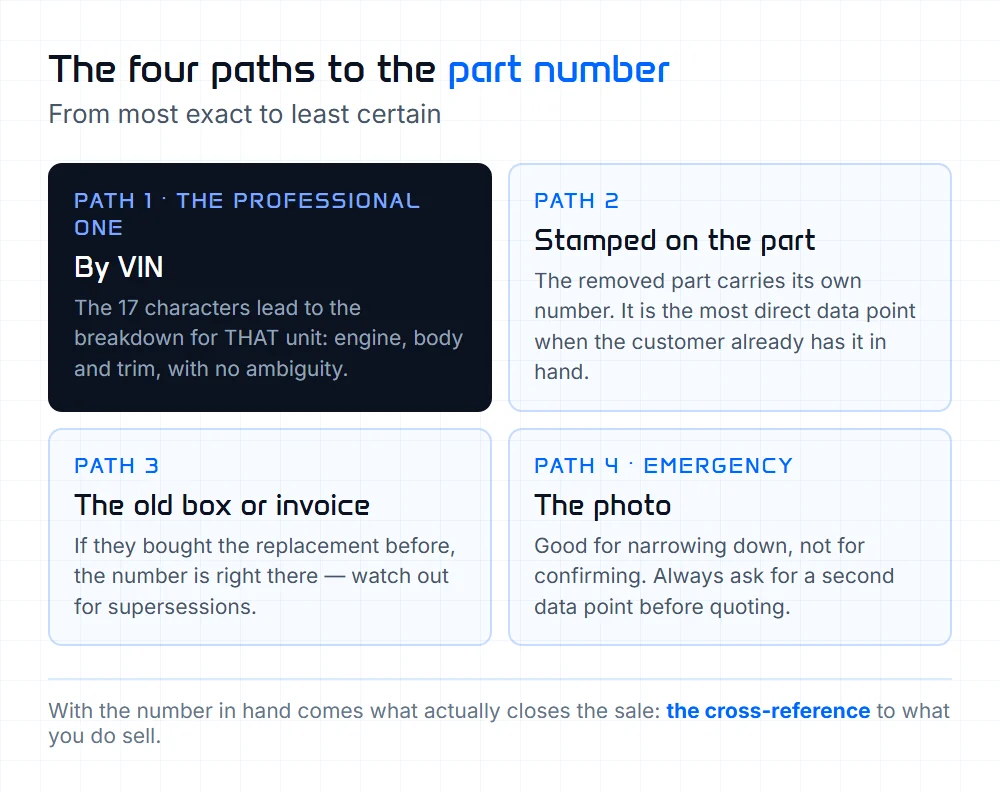
Path 1: by the vehicle VIN (the professional one)
The VIN (17 characters, at the base of the windshield and on the driver's door frame) encodes plant, year, engine and trim. With it, a catalog with applications (the brand's EPC or an ACES-style catalog) gets you the exact number THAT vehicle carries, with no guessing between trims. It is the right path whenever the part changes by engine or equipment. The full guide: decoding the VIN to sell auto parts.
Want to see how Victoria would quote this from your catalog? Send us a real quote request from your counter on WhatsApp and we answer it with your prices and stock.
Send a quote request on WhatsApp →Path 2: the number stamped on the part
Many parts carry the number stamped on them or on a label: alternators, ECUs, headlights, pumps, injectors. Before searching by vehicle, look at the part you are replacing: if the number is legible, the lookup is direct. Watch out: it may be the automaker's original SUPPLIER number (not the service number), and that is where the cross-reference comes in.
Path 3: the old box or invoice
The number from the last purchase is gold, with one trap: supersessions. Manufacturers replace numbers over time, so the one from three years ago may have been superseded. A good catalog follows the chain to the current number instead of answering "it does not exist anymore".
Path 4: the photo (the emergency one)
With no VIN, no stamped number and no box, what is left is a clear photo of both faces of the part, with something for scale, plus which vehicle it came off. An experienced counter (or a quoting tool that reads images) identifies the part type and cross-references by application from there.
And once you have the number: the cross-reference
Having the original number is almost never the end of it: the counter sells its documented aftermarket equivalent. That jump is the cross-reference, and the rule is to answer only with crosses backed by a catalog. EPC catalogs cover how each brand organizes its numbers.
💡 In our measurements of a real counter, at least 95 out of every 100 requests arrive with no part number: most come in plain language or as a photo. That is why an AI quoting tool accepts all 4 paths and answers with the number, the price and the stock in one go.
Frequently asked questions
How do I find the part number for my car?
With the VIN: its 17 characters pin down plant, year, engine and trim, and a catalog with applications (the brand's EPC or ACES-style data) gets you the exact part number for THAT vehicle.
Where is the part number on the part itself?
Stamped or on a label, depending on the part: alternators, ECUs, headlights, pumps and injectors usually carry one. If it is legible, the lookup is direct; if it is the automaker supplier's number, you have to cross-reference it to the service number.
What if the number I have no longer exists?
It was almost certainly replaced (a supersession). You follow the replacement chain to the current number and cross-reference from there to whatever equivalent you stock; answering 'it does not exist anymore' without checking the chain is losing the sale.
Can I find the part from a photo alone?
Yes, as the emergency path: a clear photo of both faces, something for scale, and which vehicle it came off. An experienced counter or a quoting tool that reads images identifies the part type and cross-references by application.
Try it with your real catalog
Victoria is Suplifai's AI quoting agent
Send Victoria a VIN, a number or a photo of the part and watch her get to the number with your price and your stock. Demo on your catalog.
You might also like